Word Clock & Fibonacci Clock Selector

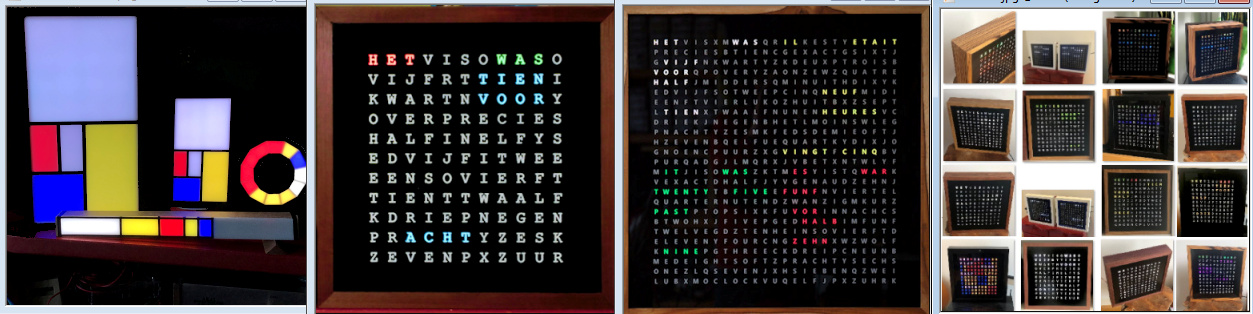
Word clocks

There are three different word clock designs, built with:

The last two support WS2812 RGB and SK6812 RGBW LEDs. All designs support Bluetooth control, a rotary encoder as backup, a DS3231 RTC for accuracy (±20 s/year), and a LDR light sensor. The Nano ESP32 also supports a built-in web page and Wi-Fi/NTP time.

With spare RGB(W) LED-strip you can also build a Fibonacci clock — a constantly changing Mondriaan-style painting that displays time in three colours.

The first word clock designs have been running for over 10 years. They use an 11×11 character grid, white 2835/3528 LED-strips, an ATMEGA328, and shift registers. Later designs moved to WS2812/SK6812 LED strips and an Arduino Nano (30×30 cm).

The four-language clock uses a 25×25 character grid. Because the French front plate required a 12×12 grid, all single-language faces were redesigned and expanded. These 12×12 clocks use an Arduino Nano Every or ATMEGA1280 with SK6812 or WS2812 strips, in standard sizes of 25×25 cm or 50×50 cm.

Since 2023, the Arduino Nano ESP32 (with onboard Wi-Fi and BLE) is used in the latest designs. Software supports English, German, French, and Dutch.

All clocks are designed on PCBs made with Fritzing (available as Fritzing and Gerber/ZIP files). Gerber files can be uploaded to a manufacturer like PCBway. KiCad can also be used, though no conversion between KiCad and Fritzing formats is currently available.

Build options:

Pros & cons of each design

⚙️

ATMEGA328 with shift registers and white LEDs

✔ Pro

  • Proven sturdy design — zero failures across 40 clocks in over 10 years
  • Can use a DCF77 time receiver

✘ Con

  • A lot of soldering (though a plus if you enjoy it)
  • No Wi-Fi NTP time
Options: Replace the Bluetooth adapter with an ESP32-C3 or S3 to add Wi-Fi NTP, or use a Nano ESP32 + HC12 transmitter to send time. Instructions are in Dutch — feel free to contact me for a translation.
🌈

Arduino Nano Every with WS2812 RGB or SK6812 RGBW LED-strips

✔ Pro

  • Full colour RGB(W) LEDs
  • Solid design — zero failures across 40 clocks in over 5 years
  • Easy to solder
  • DCF77 works if receiver is kept 10–15 cm from the LEDs

✘ Con

  • No Wi-Fi NTP time
Options: Replace the Bluetooth adapter with an ESP32-C3 or S3 to add Wi-Fi NTP, or use a Nano ESP32 + HC12 transmitter to send time.
📡

Arduino Nano ESP32 with WS2812 RGB or SK6812 RGBW

✔ Pro

  • Wi-Fi and BLE built in — control from phone or PC
  • NTP time via internet + DS3231 RTC (works offline too)
  • Software also runs on ESP32-C3/S3 and many other MCUs without a dedicated PCB — just wire up the LED-strip and DS3231

✘ Con

  • None identified
💡

Arduino Nano ESP32 with shift registers and white LEDs

✔ Pro

  • Wi-Fi and BLE built in — control from phone or PC
  • NTP time via internet + DS3231 RTC (works offline too)

✘ Con

  • A lot of soldering (though a plus if you enjoy it)
🏆

Ultimate: Nano ESP32 — white LEDs + WS2812/SK6812 on one PCB

✔ Pro

  • Wi-Fi and BLE built in — control from phone or PC
  • NTP time via internet + DS3231 RTC (works offline too)
  • One PCB that combines all capabilities of the designs above

✘ Con

  • A lot of soldering